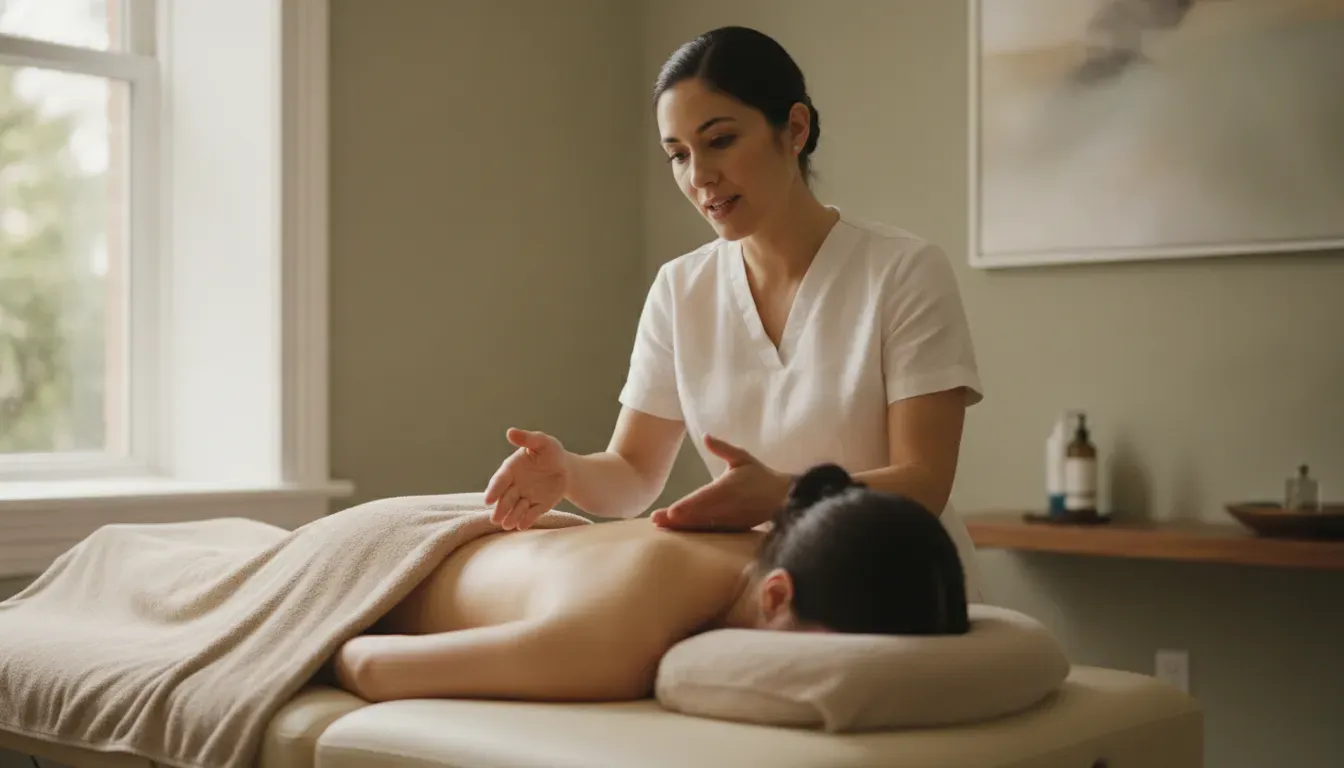

Have you ever pressed on a sore spot in your shoulder and felt a sharp ache radiate up the side of your neck or into your head? You’ve just found a trigger point. These are more than just tender spots; they are tiny contraction knots that can cause a wide range of issues, from a constant stiff neck to debilitating tension headaches. A single, active trigger point for neck pain can restrict your movement and significantly impact your quality of life. In this article, we’ll explore what these knots are, how to locate the most common ones, and what steps you can take to finally release them for good.
Key Takeaways
- Identify the source of your neck pain: Trigger points are tight muscle knots that cause both local and referred pain, like tension headaches. They often stem from common issues such as poor posture, chronic stress, and repetitive movements.
- Practice safe at-home relief: You can gently release knots by applying firm, sustained pressure for 30 to 60 seconds with your fingers or a tennis ball. The key is to use moderate pressure, listen to your body, and avoid pressing directly on bone.
- Prioritize prevention and know when to get help: Prevent future knots with daily habits like stretching, correcting your posture, and managing stress. If your pain persists, gets worse, or limits your movement, it’s time to see a professional massage therapist for expert care.
What Are Trigger Points and How Do They Cause Neck Pain?
If you’ve ever had a persistent, nagging pain in your neck, you might have been dealing with a trigger point. These pesky spots are a common source of discomfort, but understanding what they are and how they work is the first step toward finding relief. Trigger points are more than just a simple muscle ache; they are specific, tight spots that can cause pain both where they are located and in other surprising areas of your body.
What Is a Trigger Point?
Think of a trigger point as a tiny, hyper-irritable knot buried deep within your muscle tissue. It’s a small patch of muscle fiber that has become stuck in a contracted state and can’t relax. When you press on one, it usually feels tender and can be described as a tight band or nodule. These sensitive spots can cause pain right where they are, but they are also known for sending pain to other parts of your body. This is called “referred pain,” and it’s why a knot in your shoulder might be the real cause of your tension headache. A professional therapeutic massage is one of the best ways to locate and address these tricky spots.
How Trigger Points Create Neck Pain
Trigger points in the neck can develop for several reasons. Sometimes they form after an injury, like a muscle strain from a sudden movement. More often, they are the result of chronic overuse or poor posture, like hunching over a computer all day. When these knots form in your neck muscles, they restrict blood flow and create a cycle of pain and tightness. This can lead to more than just a sore neck. These trigger points are notorious for causing a wide range of symptoms, including headaches, migraines, dizziness, jaw pain, and even ringing in your ears. A skilled therapist can use techniques like deep tissue massage to release the tension and restore muscle function.
Where to Find the Most Common Neck Trigger Points
When you have a nagging pain in your neck, it’s often caused by a few specific trigger points that have become tight and irritated. These knots can be tricky because they often send pain to other areas of your head, shoulders, and back, a phenomenon known as referred pain. Getting to know these common culprits is the first step toward finding relief. By understanding where these points are located and the symptoms they cause, you can better communicate with your massage therapist about what you’re feeling. Let’s look at the four muscle groups that are most frequently responsible for neck pain.
Upper Trapezius
If you’ve ever felt like you’re carrying the weight of the world on your shoulders, you’re probably familiar with your upper trapezius. This large, diamond-shaped muscle extends from the base of your skull, out to your shoulders, and down your upper back. Trigger points here are incredibly common, especially if you spend a lot of time hunched over a computer. They can cause a deep, aching pain and stiffness, often just on one side of your neck. This tension can also lead to headaches that wrap around your head, with pain felt at the base of the skull, behind your ear, or even above your eye. A deep tissue massage can provide the focused pressure needed to work out these stubborn knots.
Levator Scapulae
Have you ever woken up with a stiff neck that makes it almost impossible to turn your head? You can likely thank a trigger point in your levator scapulae. This muscle runs down the side of your neck, from your upper vertebrae to the top of your shoulder blade. Its main job is to lift the shoulder blade, but it’s often overworked and tight. When a trigger point forms here, it creates a sharp, concentrated pain right where your neck and shoulder meet. The pain can feel like a constant “crick” in your neck and may radiate up the side of your neck or down into your upper back, making simple movements feel difficult.
Sternocleidomastoid
The sternocleidomastoid, or SCM, is a long, rope-like muscle on each side of your neck that you can feel when you turn your head to the side. While it might not be the first muscle you think of, trigger points in the SCM can cause a surprising range of symptoms. You might experience pain in your forehead, around your eyes, or in your sinuses. Some people even report feeling dizzy, nauseous, or having ringing in their ears. Because these symptoms don’t always feel like they’re coming from your neck, SCM trigger points are often overlooked. Releasing them requires a gentle but specific approach from a skilled therapist.
Suboccipitals
Tucked away at the base of your skull is a small group of four muscles called the suboccipitals. Though tiny, they play a huge role in controlling the fine movements of your head. When these muscles get tight from things like poor posture or eye strain, they can create intense tension headaches that feel like a tight band around your head. The pain is often concentrated right at the base of the skull and can radiate down your neck and into your shoulders. For these deep and persistent knots, the broad, consistent pressure of an Ashiatsu massage can be especially effective at providing lasting relief.
What Causes Neck Trigger Points?
Those tight, painful knots in your neck don’t just show up randomly. Trigger points are your body’s response to strain and stress, often stemming from your daily routines. Understanding what causes them is the first step toward finding relief and preventing them from coming back. Most of the time, the culprit is a combination of a few common habits and circumstances that put your neck muscles under pressure. Let’s look at the three main reasons you might be developing trigger points.
Poor Posture and Desk Work
If you spend hours a day hunched over a computer or looking down at your phone, you’re likely familiar with neck strain. This forward head posture forces the muscles in your neck and upper back to work overtime just to hold your head up. Over time, this constant strain can lead to tiny tears and tightness in the muscle fibers, creating painful trigger points. It’s a common issue for office workers, students, and anyone who spends a lot of time sitting. A targeted deep tissue massage can be incredibly effective at releasing the chronic tension built up from poor posture.
Stress and Muscle Tension
Ever notice your shoulders creeping up toward your ears when you’re stressed? Mental and emotional stress has a very real physical impact. When you’re anxious or overwhelmed, your body releases stress hormones that can cause your muscles to tighten unconsciously. For many people, this tension settles in the neck and shoulders. If you’re constantly in a state of high alert, your muscles never get a chance to relax fully, which can lead to the formation of trigger points. Taking time to de-stress is crucial for both your mind and your muscles.
Repetitive Movements or Injury
Sometimes, trigger points are the result of overusing certain muscles or a direct injury. Repetitive motions, like turning your head the same way all day at work, carrying a heavy bag on one shoulder, or even sleeping in an awkward position, can fatigue your muscles and cause knots to form. An acute injury, such as whiplash from a car accident or a strain from lifting something improperly, can also create trigger points as the muscle works to protect itself. For these deeper issues, a specialized treatment like Ashiatsu Deepfeet Bar Therapy can provide the consistent, deep pressure needed to release stubborn knots and aid recovery.
How to Know If You Have Neck Trigger Points
Figuring out if trigger points are the source of your neck pain can feel like a bit of detective work. These pesky knots are more than just sore spots; they can create a whole pattern of discomfort that might seem unrelated at first. The good news is that you can often identify them yourself with a little bit of awareness and self-exploration. By learning to recognize the specific symptoms and how they affect your movement, you can get a clearer picture of what’s happening in your muscles. This is the first and most important step toward finding effective relief, whether you’re working on them at home or seeking professional help.
Identify Symptoms and Referred Pain
So, what exactly are you looking for? A trigger point feels like a small, hard, and tender nodule in your muscle tissue. When you press on it, it might feel sensitive or even painful. One of the most telling signs of a trigger point is something called “referred pain.” This means the knot in your neck can send pain signals to other areas, like causing a tension headache, jaw ache, or a dull ache in your shoulder or upper back. If you have persistent stiffness or a nagging pain that seems to radiate from a specific spot, you’re likely dealing with a trigger point. A therapeutic massage can be incredibly helpful for mapping out and treating these complex pain patterns.
Check Your Range of Motion
Another major clue is a limited range of motion. Trigger points cause muscles to tighten up, which can make it difficult or painful to move your neck freely. Gently try to turn your head to look over each shoulder, or tilt your ear down toward your shoulder. Do you feel a pulling sensation or a sharp pain that stops you? Does one side feel significantly tighter than the other? Sometimes, pressing on the knot will even cause the muscle to twitch. This restriction and weakness are classic signs that a trigger point is holding your muscle hostage. A specialized treatment like Ashiatsu Deepfeet Bar Therapy can provide the deep, consistent pressure needed to release these stubborn knots and restore your movement.
How to Release Neck Trigger Points at Home
When neck pain strikes, you don’t have to wait for your next appointment to find some relief. While nothing replaces the targeted work of a professional deep tissue massage, a few simple at-home techniques can help you manage trigger points and ease discomfort. These methods are designed to gently encourage the knotted muscle fibers to release, helping you regain mobility and reduce pain. Think of it as essential maintenance you can perform between your professional sessions. By learning how to address these knots yourself, you can take an active role in your wellness and keep your neck muscles feeling more relaxed day-to-day.
Use Your Hands to Apply Pressure
One of the most direct ways to address a trigger point is with your own hands. Start by gently exploring the muscles in your neck and upper shoulders to find a spot that feels tight and tender, like a small, hard pea under the skin. Once you’ve located a knot, use your fingertips, thumb, or knuckle to apply firm, sustained pressure directly onto it. Hold this pressure for about 30 to 60 seconds. You should feel a significant amount of pressure, often described as a “good hurt,” but it should never be sharp or cause you to wince. Breathe deeply as you hold the pressure, and you might feel the knot begin to soften and release.
Try Heat Therapy and Simple Tools
To make your self-massage more effective, try incorporating heat and simple tools. Applying a warm compress or taking a hot shower before you begin can help relax the muscle, making it more receptive to pressure. The therapeutic warmth used in a Hot Himalayan Salt Stone massage works on this same principle, soothing muscles to allow for deeper work. For hard-to-reach spots, a tennis ball or lacrosse ball can be a great help. Simply place the ball between your back and a wall, and lean into it to apply pressure to trigger points in your upper back and shoulders that contribute to neck pain. After you’re done, a gentle stretch can help lengthen the muscle.
Apply the Right Pressure for the Right Amount of Time
Finding the right amount of pressure is key to successfully releasing a trigger point. You want to apply enough force to create change in the muscle tissue, but not so much that your body tenses up in response. On a pain scale of 1 to 10, aim for a 5 to 7. It should feel deeply uncomfortable but still tolerable. Hold this pressure steadily for 30 to 60 seconds, breathing the entire time. Releasing the pressure too soon won’t give the muscle enough time to respond, while holding it for too long can cause irritation. Listen to your body; if the pain becomes sharp or shooting, ease up immediately. Consistency is more important than intensity.
Common Mistakes to Avoid When Treating Trigger Points
Working on your own trigger points can be incredibly empowering, but it’s easy to make a few common mistakes that might slow your progress or even make the pain worse. When you’re trying to release those stubborn knots at home, a gentle and patient approach is always the best policy. By learning what to avoid, you can make your self-massage sessions safer and much more effective. Let’s walk through a few common pitfalls to sidestep on your path to neck pain relief.
Applying Too Much Pressure
It’s tempting to think that more pressure equals better results, but that’s not the case with trigger points. Applying too much force can cause the muscle to tighten up in defense, which is the opposite of what you want. The goal is to find a “good pain” spot, a level of pressure that feels tender and effective but not sharp or unbearable. If you find yourself wincing or holding your breath, you’re pressing too hard. A professional therapist is trained to find that perfect balance. For stubborn knots, a deep tissue massage can provide the firm, consistent pressure needed without causing further irritation.
Pressing on Bone Instead of Muscle
This one is crucial for safety. Make sure you are always working on soft, muscular tissue, not bone. Pressing directly on your vertebrae or collarbone won’t release a trigger point and can be painful or even cause injury. Before you apply pressure, feel the area with your fingers. Muscle should feel pliable, even when tight, while bone will feel hard and unyielding. A licensed massage therapist has the anatomical knowledge to pinpoint trigger points with precision while safely avoiding sensitive structures. This expertise is key to receiving a safe and effective massage.
Expecting Instant Results
Trigger points, especially those that have been around for a while, rarely disappear after one session. They developed over time from stress or posture habits, and they often require consistent attention to fully release. While at-home care is fantastic for maintenance, don’t get discouraged if the knot is still there after your first try. If your pain doesn’t improve or gets worse, it’s a clear sign to seek professional help. A skilled therapist can use specialized techniques, like Ashiatsu Deepfeet Bar Therapy, to provide the broad, consistent pressure needed for lasting relief.
How to Prevent Neck Trigger Points with Daily Care
Releasing trigger points brings incredible relief, but the real goal is to keep them from coming back. Prevention is all about creating healthy habits that reduce strain on your neck muscles. By making a few small adjustments to your daily routine, you can manage tension, improve your posture, and keep your neck feeling loose and pain-free. Think of it as ongoing maintenance for your body, ensuring those pesky knots don’t get a chance to form in the first place.
Stretch Your Neck Daily
One of the simplest and most effective ways to prevent trigger points is to stretch your neck every day. Gentle stretching helps maintain your range of motion and eases muscle tightness before it becomes a problem. You don’t need a lot of time, just a few minutes. Try slowly tilting your head to bring your ear toward your shoulder, holding for 20-30 seconds on each side. You can also gently lower your chin to your chest to stretch the back of your neck. Remember to keep your movements slow and avoid any sharp pain. Staying hydrated is also key, as water helps keep your muscle tissue healthy and less prone to knots. A few simple neck stretches throughout the day can make a world of difference.
Correct Your Posture and Build Strength
Poor posture is a primary cause of neck pain and trigger points, especially if you spend hours at a desk or looking down at your phone. When your head juts forward, it puts a huge amount of strain on your neck and upper back muscles. A simple way to correct your posture is to imagine a string gently pulling the crown of your head toward the ceiling, aligning your ears over your shoulders. Strengthening the muscles in your upper back and neck also provides better support for your head. Simple exercises like rows and shoulder blade squeezes can help build the endurance you need to maintain good posture throughout the day, preventing the muscle fatigue that leads to trigger points.
Manage Stress and Modify Your Habits
Stress is a major contributor to muscle tension. When you’re stressed, you might unconsciously clench your jaw or hunch your shoulders, which tightens the muscles in your neck and can activate trigger points. Finding healthy ways to manage stress, like deep breathing exercises, meditation, or even a relaxing Swedish massage, can help release that tension. Also, take a look at your daily habits. Are you cradling your phone between your ear and shoulder? Are you sleeping with too many pillows? Small, repetitive movements or sustained positions can create strain over time. Making simple changes, like using a headset or adjusting your sleeping position, can prevent trigger points from developing.
When to Get Professional Help for Neck Trigger Points
While at-home techniques are fantastic for managing mild discomfort, they have their limits. Sometimes, a stubborn trigger point requires a more experienced touch. A professional massage therapist is trained to find and release knots that you might struggle to reach or treat effectively on your own. They can apply precise, consistent pressure to coax the muscle into letting go. If you’ve been working on a trigger point for a while without seeing results, or if the pain is interfering with your daily life, it’s a good idea to book an appointment.
Think of it this way: you can handle the day-to-day maintenance, but for the deep work, you call in an expert. A professional can also help identify the underlying causes of your trigger points, like postural imbalances, and give you personalized stretches and advice to prevent them from coming back. Getting expert help isn’t a sign of failure; it’s a smart step toward feeling your best.
Signs You Need a Professional Massage
It’s time to let a professional take over if your self-care efforts aren’t cutting it. Pay attention to your body. You should schedule a professional massage if you notice any of the following signs:
- The pain isn’t getting better after a few weeks, or it’s actually getting worse.
- The muscle tightness is so severe that it makes it hard to turn your head or move freely.
- Referred pain, like tension headaches or pain radiating down your arm, just won’t go away.
- You feel any tingling, numbness, or weakness along with the muscle pain. These symptoms could point to nerve involvement, which needs a professional evaluation.
A licensed massage therapist has the anatomical knowledge to safely and effectively address these more persistent issues.
The Long-Term Benefits of Professional Treatment
Seeing a professional isn’t just about getting immediate relief; it’s an investment in your long-term well-being. Trigger points are treatable and not something you have to live with forever. A skilled therapist can use advanced techniques like Ashiatsu Deepfeet Bar Therapy or targeted deep tissue work to release chronic knots that self-massage can’t resolve.
Beyond the treatment itself, a professional can help you break the cycle of pain. They can assess your posture and movement patterns to pinpoint what’s causing the trigger points in the first place. With their guidance, you can make small, effective changes to your daily habits to keep your neck muscles happy and relaxed. Consistent professional care helps retrain your muscles, preventing future flare-ups and leading to lasting comfort.
Related Articles
Frequently Asked Questions
What’s the difference between a trigger point and a regular muscle knot? Think of it this way: all trigger points are knots, but not all knots are trigger points. A regular muscle knot is simply a tight, tender spot in your muscle. A trigger point is a more irritable version of that knot. The key difference is that a trigger point is known for causing “referred pain,” which means it can send pain signals to other parts of your body. That’s why a specific knot in your shoulder might be the real source of your tension headache.
Why does a knot in my neck give me a headache? This happens because of that referred pain we just mentioned. The nerves in your neck and head are all connected in a complex network. When a trigger point in a neck muscle becomes irritated, it sends out strong pain signals. Your brain can get these signals confused and misinterpret where the pain is actually coming from. As a result, you might feel the pain in your forehead, temples, or behind your eyes, even though the problem is located in your neck.
Is it normal to feel sore after working on a trigger point? Yes, it’s very normal to feel a bit tender for a day or two after a focused massage or a self-treatment session. This is similar to the soreness you might feel after a challenging workout. Your muscles are being worked in a way they aren’t used to, which helps release chronic tension. This feeling should be a dull ache, not a sharp pain. Drinking plenty of water and applying a little heat can help ease this post-massage soreness.
How often should I try to release my neck trigger points at home? When it comes to at-home care, consistency is much more important than intensity. You can work on a specific knot for about 30 to 60 seconds, once or twice a day. It’s important to listen to your body. If an area feels too bruised or sensitive, give it a day or two to recover before working on it again. The goal is gentle and regular maintenance, not an aggressive approach.
Which type of professional massage is best for stubborn neck knots? For stubborn neck knots, both Deep Tissue massage and Ashiatsu Deepfeet Bar Therapy are fantastic options. A Deep Tissue massage uses firm pressure from hands, knuckles, and elbows to target and release specific trigger points. If you have very deep or widespread tension, Ashiatsu can be especially effective. It uses the therapist’s body weight and feet to deliver broad, consistent pressure that can release deep knots without the sharp feeling that sometimes comes with more pointed tools.