When Parkinson’s affects daily routines, planning a massage session may bring practical questions about comfort, communication, and what to expect. There is no single approach that fits everyone, and a person’s preferences and circumstances can change from one appointment to the next.
Book your massage appointment online
Massage for parkinson’s may be considered as a comfort-focused wellness service, not a treatment for Parkinson’s or a way to control its symptoms. Talk with your treating clinician about individual questions. Share relevant needs and preferences with the massage therapist. Together, you can discuss and adjust choices with your consent.
A thoughtful plan starts with realistic expectations: what massage may offer as a supportive experience, and what it cannot promise. Understanding that distinction can help people with Parkinson’s and care partners decide what questions to raise before an appointment.
What Can Massage for Parkinson’s Offer, and What Can It Not Do?
Massage may be considered as an optional wellness experience, not as a way to treat Parkinson’s disease. A person might choose it for the familiar reasons people seek massage, such as setting aside time for rest or enjoying a calming, attentive session. Whether it feels comfortable or worthwhile is individual. It should not be presented as a reliable way to change Parkinson’s symptoms.
That distinction matters. Parkinson’s is a neurological condition managed with guidance from a person’s healthcare team. Massage does not replace prescribed medication, specialist care, or recommended therapies. A massage therapist should not diagnose Parkinson’s, adjust treatment, or promise disease control. If the goal is to address a symptom or make a health decision, discuss that with the clinician who knows the person’s medical history.
Research specifically about massage and Parkinson’s remains limited. A 2020 systematic literature review examined massage therapy as a complementary approach for Parkinson’s disease. But the existence of a review does not establish that massage is an effective treatment. Its findings should not be turned into a promise that massage will improve movement, tremor, stiffness, sleep, or another symptom. Read the systematic review on PubMed.
A published 2016 case report describes one person’s experience with massage. A case report can document what happened in an individual situation. But it cannot show that massage caused the outcome or that other people with Parkinson’s will have the same experience. It is not enough to establish efficacy or support a general treatment claim. Read the case report in PubMed Central.
So, a realistic reason to consider an appointment is personal comfort or the experience of receiving care, with expectations kept modest. It is also reasonable to decide that massage is not right for you, or to stop if the session is not comfortable. The person receiving care remains the decision-maker. Preferences can be discussed before the session and changed at any point. A care partner may help communicate if invited, but should not speak over the person’s choices.
Think of massage as a possible addition to a broader wellness routine, not a Parkinson’s therapy. If you are unsure whether an appointment fits your situation, ask your treating clinician about your specific questions before booking. The next step is to plan communication and comfort with the therapist, without assuming a particular technique or outcome.
When Should You Talk With a Parkinson’s Clinician First?
Massage can be considered as a complementary comfort choice, not as a treatment for Parkinson’s or a substitute for care from your health team. Whether a session feels appropriate is individual. If you have a question about how massage fits with your health, treatment plan, or current needs, ask the clinician who knows your situation before booking. That may be your Parkinson’s specialist, neurologist, nurse specialist, or another member of your treating team.
It is especially sensible to check in when your health or daily needs have changed since your last appointment. Or when you are unsure whether a particular session plan is suitable for you. Rather than trying to decide from a general article. Describe your question to your clinician and ask whether there is anything the massage therapist should know or coordinate around. This is not because Parkinson’s automatically rules out massage. It is a way to get advice that takes your own circumstances into account.
NICE guidance emphasizes that people with Parkinson’s should be empowered to participate in choices about their care. It also recommends communication that is individually tailored and reinforced when needed. A care plan should be agreed with the person and relevant family members, carers, and healthcare providers. Those principles can support a practical conversation about a complementary service such as massage. Read the NICE recommendations for Parkinson’s disease in adults.
You can ask your clinician a focused question. Such as whether you should share any particular information with the therapist or whether you should wait until a health concern has been reviewed. If you have a care partner, you may choose to include them in that conversation, but your preferences should guide their involvement. A care partner can help you remember questions or communicate details when you want that support.
At the studio, share relevant information about your comfort, needs, and preferences so the therapist can discuss an individualized session with you. The conversation does not replace clinical advice. The therapist should not be expected to assess Parkinson’s or change medical care. If your treating team recommends waiting, or you do not yet feel confident about proceeding, defer the appointment and revisit it after you have the guidance you need. The goal is a considered, client-led comfort choice, with medical questions answered by the people responsible for your care.
How Can You Make Intake and Consent Client-Led?
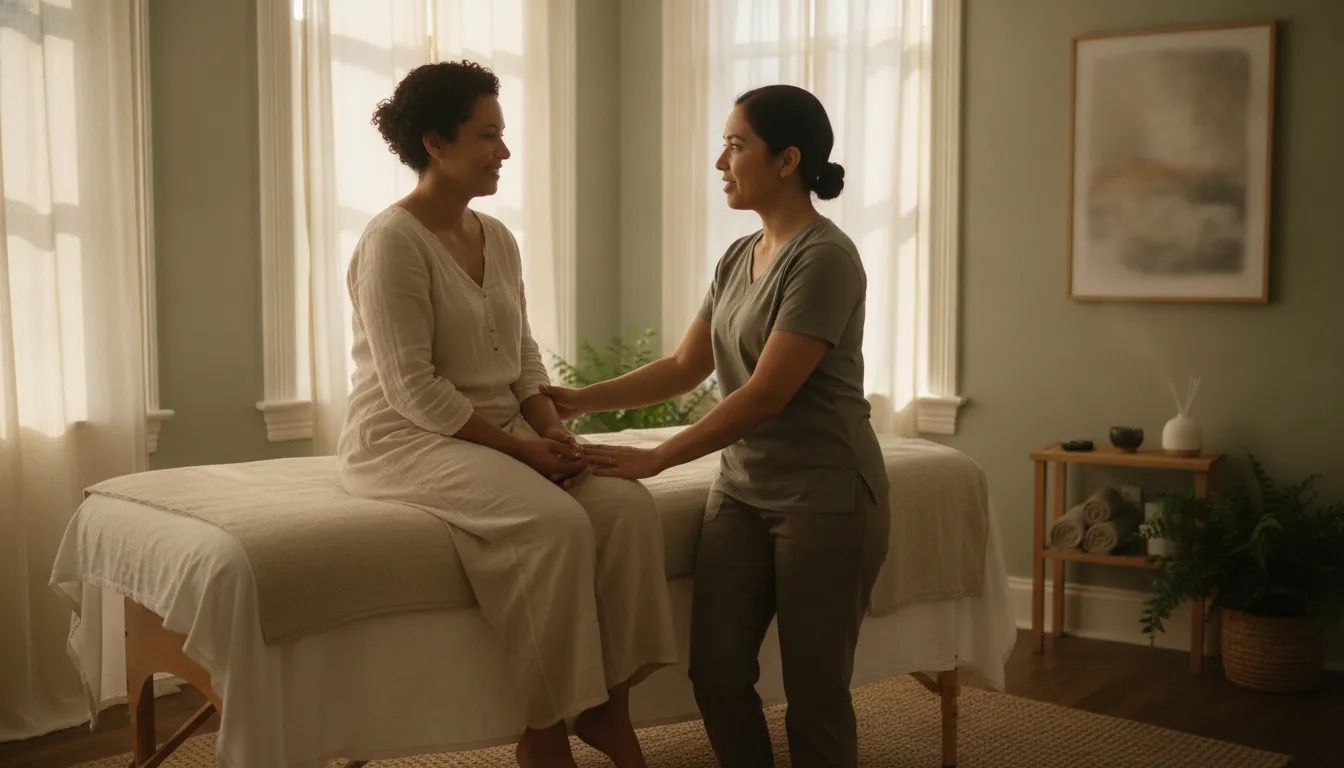
Start by speaking directly with the person receiving the massage and asking what would help them feel comfortable. Parkinson’s affects people differently. A diagnosis does not tell a therapist what someone can understand, communicate, or decide. The client is the decision-maker about their session. A care partner may help share information or clarify preferences if the client wants that support, but their involvement should not replace the client’s voice.
Before the appointment, the client can choose what health history to share, including relevant changes, areas of discomfort, or questions about whether massage fits alongside their care. A simple guide to sharing health history before massage can help organize those details. There is no need to disclose more than feels relevant. The goal is to give the therapist information that can guide a respectful conversation, not to make a diagnosis.
It can also help to describe preferences and practical needs in the client’s own words. For example, they might prefer a quieter explanation before each change, extra time to get settled, or a chance to discuss a comfortable position before beginning. If speech, writing, movement, or another part of communication takes more effort on a particular day, ask what method works best rather than assuming. NICE recommends that communication with people with Parkinson’s be tailored and reinforced as needed, with the aim of empowering their participation in choices about care. NICE guidance on Parkinson’s disease also describes involving family members or carers as appropriate in care planning. That does not remove the person’s role in decisions.
Consent is not a one-time form. Before the session, agree on how the client can ask a question, request a change, or pause. During the massage, the therapist can check whether the current approach still feels acceptable. The client can change their mind at any point. A client-led approach to massage communication and consent offers more context for these conversations.
If a care partner is present, agree together what support the client wants, such as helping recall a preference or staying nearby. Check directly with the client before sharing information or accepting suggestions on their behalf. These small choices keep the appointment collaborative and give the client room to guide what happens, including choosing not to proceed with any part of the session.
Which Session Adjustments Could Support Comfort?
Comfort can depend on the day, the person, and what feels manageable in the moment. Rather than assuming one approach fits everyone with Parkinson’s, use the intake conversation to describe priorities, preferences, and anything the therapist should know. NOLA Bliss Massage’s general intake includes health history, pain assessment, and goal setting. It is not a Parkinson’s-specific protocol.
Pressure is one possible point to discuss. The studio offers Swedish massage with pressure customized from light to medium. Deep-tissue pressure is adjusted to individual client needs. Those descriptions do not establish that either style is suitable for a particular person. A client can explain what has felt comfortable before, ask to begin conservatively, and request a change or pause at any time. The therapist should follow the client’s feedback rather than treating a service name as a fixed plan.
Technique and session duration can also be discussed. NOLA Bliss says its sessions can be tailored by technique and length. A shorter appointment, a different focus, or less hands-on time may be worth asking about if that better matches the person’s energy or preferences. No duration or method is a universal recommendation for Parkinson’s. A treating clinician can help answer personal medical questions that are outside the therapist’s role.
Positioning is another practical topic to raise before the session and revisit as needed. Explain what feels stable and comfortable, and ask what positioning options the therapist can offer. Do not assume a particular position is appropriate. Comfort and ability to communicate clearly matter more than completing a preset routine. During the appointment, the client can give feedback directly or agree in advance on how a care partner may help communicate, if the client wants that support.
NOLA Bliss Massage does not claim Parkinson’s-specific training or a Parkinson’s massage protocol. Its licensed therapists can discuss general service options, but that is different from specialized neurological care. For examples of individualized discussion about pressure, length, and positioning in another health context, see the guide to gentle massage session adjustments. You can also review the studio’s massage services before asking which options may be workable for your needs.
How Can You Prepare for a First Appointment?
A little preparation can make it easier to explain what would help you feel comfortable and what you would like the therapist to know. There is no need to arrive with a prescribed technique or a perfect script. Your preferences can guide a conversation, and you can revise them during the appointment.
- Decide what you hope to get from the visit. You might want quiet time, a comfortable experience, or attention to a particular area of tension. Keep the goal personal and realistic. Massage is not a treatment for Parkinson’s, and you do not need to prove that a particular approach will work.
- Gather relevant health details and preferences. Note any health history, current concerns, areas you would rather avoid, and preferences about pressure or conversation during the session. The studio’s general intake includes health history, pain assessment, and goal setting. This is not a Parkinson’s-specific protocol. The guide to sharing health history before massage can help you think through what to communicate.
- Ask your clinician about individual medical questions. If you are unsure whether massage fits your situation or have questions about coordinating it with your care, raise them with the clinician who knows your health history. You can bring any guidance you receive to the therapist, without expecting the therapist to diagnose or advise on Parkinson’s care.
- Describe practical needs for the session. Let the studio know if mobility, getting on or off the table, positioning, communicating, or taking breaks may need discussion. You can also ask whether a support person may accompany you. Decide together what role, if any, that person should have, and make sure their involvement is with your consent. Do not assume a particular accommodation is available. Ask about your needs before booking.
- Agree on a simple way to pause or change course. Before the massage begins, choose a word or gesture you can use to ask for a pause, a different approach, or an end to the session. Confirm that the therapist understands and check that it feels easy for you to use. You remain in control of whether to continue.
When you are ready, you can review the studio’s massage services and share your questions or preferences while arranging an appointment. Clear communication helps the therapist understand what you want from the visit, while leaving room to adjust as needed.
Session Options to Discuss Before Booking
| Topic | Helpful question | Important limit |
|---|---|---|
| Pressure | What level feels comfortable, and how can I ask for a change? | A service label does not determine what is right for one person. |
| Positioning | What position feels stable, and what alternatives can we discuss? | Do not assume a position or transfer is suitable without discussing it. |
| Session length | Would a different appointment length better fit my preferences? | No duration is a Parkinson’s-specific recommendation. |
| Communication | How can I pause, give feedback, or stop? | Consent continues throughout the session. |
This is a conversation aid, not medical advice or a prescribed Parkinson’s protocol. Share questions with your therapist and ask your treating clinician about individual health concerns.
When Is It Better to Pause and Revisit the Plan?
A massage appointment is not something you need to push through. If you feel unwell, uncomfortable, overwhelmed, or simply want a change, tell your therapist and ask to pause. You can also request an adjustment or stop the session. Your comfort and choice matter throughout the appointment, not only during the initial conversation.
There is no need to explain or justify a change in preference. You might want to pause while you gather your thoughts, change what you are comfortable with, or end the appointment. The therapist should listen and follow your direction. If speaking feels difficult in the moment, agree beforehand on a simple way to signal that you want the session to stop or change. A care partner may help communicate only if you want them involved.
Feeling unwell or having a new concern is a reason to stop and check in, rather than trying to decide on your own whether massage is appropriate. A massage therapist can discuss comfort and session preferences, but cannot answer personal medical questions or determine what is safe for your specific health situation. Contact your treating clinician for guidance about symptoms, treatment, or whether and when to try massage again. If you already have questions about a health condition or how it may affect a session, raise them with your clinician before booking.
Once your clinician has addressed those questions, you can revisit the plan with the massage therapist. Share only the information you are comfortable sharing, including any guidance that affects your preferences. Together, you can decide whether to reschedule, adjust the appointment, or leave massage off the plan for now. A previous appointment or a general description of massage cannot establish that it will suit every person with Parkinson’s.
For general information about situations that may call for extra care or a change to a massage plan, see NOLA Bliss Massage’s guide to massage contraindications. It is not a substitute for advice from your own clinician. When a concern is specific to you, get that guidance first, then make a choice that feels comfortable and voluntary.
Book your massage appointment online
Frequently Asked Questions
What kind of massage is best for Parkinson’s?
There is no single massage style that is best for everyone with Parkinson’s. The right choice depends on the person’s health, comfort, preferences, and goals. Talk with the treating clinician about individual concerns, then discuss pressure and technique options with the massage therapist. Choose an approach the client wants and can comfortably tolerate. Massage is not a treatment for Parkinson’s.
Should someone with Parkinson’s check with a clinician before booking?
If there are questions about whether massage fits the person’s health or current care plan, ask the treating clinician before booking. Share relevant guidance with the massage therapist during intake, including any concerns about pain, mobility, or comfort. A massage therapist can tailor a general session, but cannot replace the clinician’s advice or determine medical suitability.
Can a care partner join the conversation or appointment?
A care partner can help communicate preferences or take part in planning when the client wants that support. Ask the client first, and keep decisions and ongoing consent with them. Parkinson’s care guidance emphasizes involving the person in choices and including family or carers as appropriate, not by default (NICE guidance).
Can massage ease Parkinson’s symptoms?
Massage should not be presented as a way to treat Parkinson’s, slow its progression, or control symptoms. Research has examined massage as a complementary approach, but that does not establish it as a Parkinson’s treatment (systematic review). If the goal is comfort or relaxation, discuss realistic expectations with the therapist and keep the treating clinician informed about individual health questions.
Book a Comfort-Focused Massage Appointment
A massage appointment is a personal choice, and sharing preferences can help make the session-planning conversation more useful. NOLA Bliss Massage does not offer Parkinson’s treatment, so bring individual medical questions to the treating clinician. If you would like to explore whether a comfort-focused appointment may fit your preferences, book online with NOLA Bliss Massage and share any session needs you would like considered.