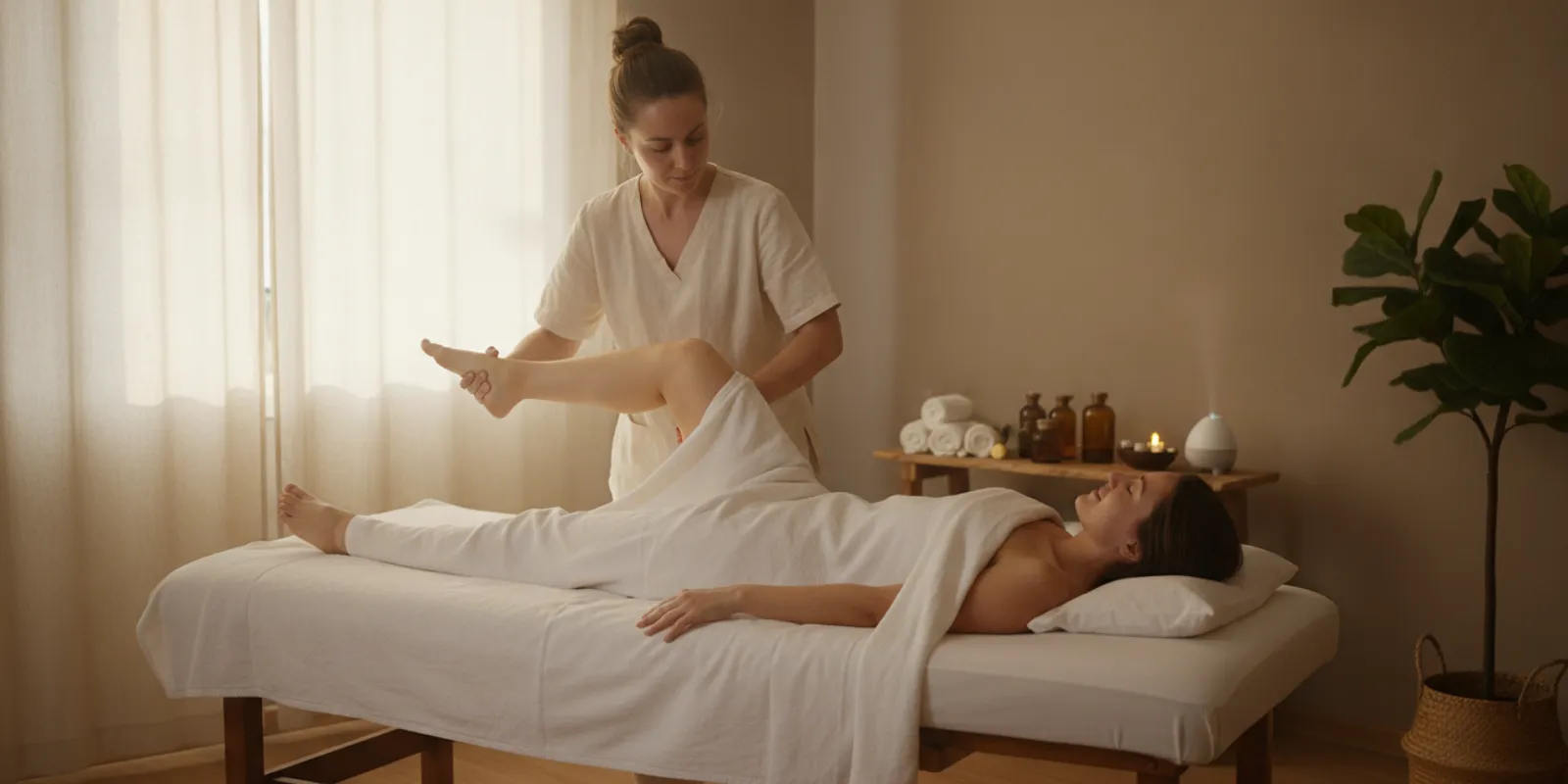

When you search for massage for swelling, you may be looking for relief from puffiness, a heavy feeling, or fluid buildup. The safest next step depends on why the swelling is happening. Massage is not a substitute for medical evaluation, and ordinary massage should not be assumed to move fluid or treat a health condition. Start by identifying warning signs and discussing the cause with a healthcare professional.
Ask about your massage options
What can swelling mean?
Swelling is an increase in fluid in body tissues. It can appear in one area or affect a larger part of the body. A minor injury or a long period of sitting may be part of the picture, but swelling can also have causes that need medical attention. A massage therapist cannot diagnose the cause based on appearance or sensation alone.
Pay attention to when the swelling began, where it is, whether it is changing, and any other symptoms. Sudden or severe swelling, swelling that is painful, red, warm, or rapidly worsening, or swelling accompanied by shortness of breath or chest pain should be assessed promptly by a medical professional. If you are unsure whether a symptom is urgent, contact a healthcare provider or emergency service rather than booking a massage first.
New or persistent swelling deserves medical guidance even when it does not hurt. Share the information with your clinician, including recent illness, injury, travel, changes in activity, or relevant health conditions. They can assess whether massage is appropriate and whether a specific treatment plan is needed.
It can help to separate what you can observe from what you suspect. For example, note that one ankle looks more swollen than the other, or that a ring feels tighter than usual, rather than deciding on your own what caused the change. A simple timeline is useful: when you first noticed it, whether it has changed, and what else was happening around that time. Those details give a healthcare professional a clearer starting point without asking you to diagnose yourself.
Can massage help with swelling?
It depends on the cause and on the type of massage. Manual lymphatic drainage is a specialized, gentle technique that may be used in specific situations, including some cases of swelling related to a lymphatic problem or medical treatment. It is different from a general relaxation or therapeutic massage. Cleveland Clinic explains that lymphatic drainage massage is used to help relieve swelling when illness or medical treatment affects the lymphatic system (Cleveland Clinic’s overview of lymphatic drainage massage).
That does not mean every swollen area should be massaged, or that any massage can treat the underlying cause. Even gentle techniques may be unsuitable in some circumstances. Ask the clinician managing your care whether massage is appropriate, what technique and area are acceptable, and whether there are restrictions. If they recommend a specific form of lymphatic care, ask how to find a provider with appropriate training for that treatment.
Regular therapeutic massage has a different purpose. A session may focus on comfort, relaxation, or muscle tension, but it should not be presented as a treatment for unexplained swelling. At NOLA Bliss Massage, the available massage approaches are outlined on the massage services page. That list can help you understand the general options, but it does not establish that a particular service is appropriate for your swelling.
A useful way to think about the decision is to ask two separate questions: “What is causing the swelling?” and “Is massage appropriate for my other goals?” The first belongs with a healthcare professional. The second can be discussed with a massage provider after you have relevant medical guidance. Keeping the questions separate helps prevent a general comfort session from being mistaken for care directed at fluid buildup.
Which next step fits your situation?
Use this comparison as a planning aid, not a diagnosis. When in doubt, choose medical advice first. A massage appointment is not a replacement for an examination, and the right option may be to postpone massage until you have more information.
| Situation | Safer next step | What to clarify |
|---|---|---|
| Sudden, severe, rapidly worsening, or unexplained swelling | Contact a healthcare professional promptly; seek urgent help for emergency symptoms. | Cause, urgency, and whether massage should be avoided. |
| Swelling connected to a diagnosed condition or medical treatment | Ask the clinician managing your care about massage and any restrictions. | Permitted areas, technique, pressure, timing, and any need for specialized care. |
| A clinician has recommended a specific lymphatic technique | Ask for guidance on an appropriately trained provider and share the care instructions. | Whether the provider offers that technique and can follow the guidance. |
| No swelling concern, but you want help with general muscle tension or relaxation | Explore a suitable therapeutic massage option and explain your goals before the session. | Comfort, pressure preferences, relevant health history, and areas to avoid. |
Before acting, walk through the choice in order. First, decide whether symptoms need urgent attention; do not wait for a massage appointment if they do. Next, if the swelling is new, persistent, or unexplained, contact a healthcare professional and ask what evaluation is appropriate. Then ask specifically whether massage is safe for you, not just whether massage is generally used for some forms of swelling. Finally, if massage is approved, confirm the technique, body areas, pressure, and timing that fit your instructions. This sequence makes it easier to choose an appointment for a clear purpose.
For instance, a person with a clinician-managed condition may be told to seek a particular lymphatic treatment and to avoid certain areas. That is different from a visitor who notices new swelling after a day of travel and has not yet discussed it with a clinician. Neither person should assume a standard therapeutic massage is the right response; the guidance and next step depend on the individual situation.
What should you discuss before a massage?
Be direct about the swelling and what you know about it. You do not need to diagnose yourself. Say when it started, where it is, whether it is changing, and whether a healthcare professional has assessed it. Mention relevant instructions or restrictions from your clinician. This helps the therapist understand your request and whether it is appropriate to continue with a general massage session.
- Describe what you notice. Explain the location, timing, and any changes or discomfort.
- Share medical guidance. Bring up a diagnosis, recent procedure, treatment, injury, or clinician’s recommendation if relevant.
- Ask about scope. Find out whether the requested technique is offered and what it is intended to address. Do not assume a standard massage is manual lymphatic drainage.
- Discuss boundaries. Tell the therapist about tender areas, areas to avoid, and your pressure preferences.
- Be willing to pause. If symptoms change or new discomfort appears, say so. If the cause is unknown, rescheduling until you have medical guidance may be the safer choice.
You can make the conversation concrete with a short summary: “I noticed swelling in this area on this day. It has changed in this way. I have or have not spoken with a healthcare professional, and these are the instructions I received.” Then ask whether the service being considered matches those instructions. If you do not know whether massage is allowed, say that plainly and get medical guidance before proceeding.
Ask what the session will and will not address. A clear explanation should distinguish general relaxation or muscle work from specialized lymphatic care, and should not promise to resolve an unexplained symptom. If the provider cannot confirm that a requested technique is offered, or if the technique differs from the one your clinician recommended, pause and check with the clinician rather than treating the approaches as interchangeable.
A professional conversation should leave room for questions and for the answer “this needs medical guidance first.” NOLA Bliss describes its background and therapeutic focus on its about page. For questions about fit or availability, use the contact page rather than assuming a particular technique is available.
How is lymphatic drainage different from regular massage?
Lymphatic drainage massage uses very light pressure and a particular approach; it is not simply a deep massage or a general massage with lighter pressure. Cedars-Sinai describes the technique as using light pressure to move fluid toward the heart (Cedars-Sinai’s lymphatic drainage massage FAQs). The details of whether, where, and how it may be used depend on the person and their clinical situation.
The distinction is about method and purpose, not just how a session feels. Lymphatic drainage follows a specific approach and is not a general substitute for medical care. Therapeutic massage styles, meanwhile, can involve different pressure and focus depending on the service and the client’s goals. Lighter pressure alone does not make a session lymphatic drainage, and a familiar massage approach does not become suitable for swelling simply because the therapist avoids pressing hard.
By contrast, therapeutic massage approaches can vary in pressure and focus. A technique intended to address muscle tension is not interchangeable with a specialized lymphatic technique. For instance, NOLA Bliss describes Ashiatsu massage as a distinct service; its existence does not make it an appropriate choice for swelling. If your clinician has given you instructions, do not substitute another massage style for the method they recommended.
If you are referred for lymphatic work, ask the referring clinician what qualifications or training to look for and whether the treatment should be coordinated with other care. When contacting a provider, use the name of the technique from your instructions and confirm whether it is offered. Ask what information they need before scheduling and whether they can accommodate any specified limits. These practical questions can prevent confusion between a requested specialized treatment and a different service that may have another goal.
What if the swelling is near an area of muscle tension?
There may be two separate concerns: swelling that needs medical assessment and muscle tension that you want to address. Discuss both, but do not ask a therapist to work directly on a swollen area unless a qualified healthcare professional has said massage is appropriate there. A clinician can advise whether any nearby or general massage is suitable and when to avoid it.
If you are seeking general support for neck or back tension and swelling is not the reason for treatment, you can read the studio’s back and neck massage guide as a separate starting point. It is still important to mention health concerns before a session and to follow medical advice about any symptoms.
Be precise about the area you hope to address. “My shoulder feels tight, and I also have swelling in my hand” gives a provider more useful context than simply asking for a full-body massage. It also allows you to explain what a clinician has said about the swelling and whether nearby work is permitted. If there is no medical guidance yet, do not use work on a separate tense area as a reason to ignore or postpone an assessment of the swelling.
How can you plan a massage appointment in New Orleans?
Once you have confirmed that massage is appropriate, choose the session based on your goals and the provider’s available services. Be clear when you contact the studio: explain that swelling is part of your concern and ask whether the available service fits the guidance you received. If the answer is uncertain, check with your healthcare professional before booking.
For a general therapeutic massage, the service overview is a place to compare the listed approaches. Visitors planning a downtown appointment can also review parking information. Logistics do not determine clinical suitability, so keep the medical question separate from the travel and scheduling details.
NOLA Bliss Massage is in the Warehouse District of Downtown New Orleans. If you are visiting, give yourself enough time to arrive and communicate your needs before the session begins. You can use the studio’s contact details to ask a specific service question. Do not rely on an online article or booking conversation to diagnose a new symptom.
When you make contact, keep your questions practical: Is the requested service available? Is it the same technique named in your clinician’s guidance? What should you share before the appointment? If you have written instructions, ask whether they can be reviewed before a session is confirmed. Avoid giving a provider the responsibility of deciding whether a medical condition is safe to treat; that decision should come from your healthcare professional.
If you are a local resident planning follow-up care, write down the guidance you receive so you can refer to it when booking or at a later appointment. If you are traveling, consider whether the timing allows you to seek medical advice before the session. A convenient location or open appointment does not change the need to confirm that massage is appropriate for the specific concern.
What information should you have ready?
A short, factual account can make a conversation with your healthcare professional more useful. Note when you first noticed the swelling and whether it changes during the day or after a particular activity. Record whether it affects one area or both sides, and whether you have pain, warmth, skin changes, or other symptoms. You do not need to interpret those details; they simply help a clinician understand what has changed.
It can also help to list recent injuries, procedures, illness, travel, and medications or treatments you are taking. Do not stop or change a medication because of swelling unless the prescribing clinician advises you to do so. If a healthcare professional has already assessed the concern, ask whether there are written instructions you can share with the massage provider, especially about areas to avoid, pressure, positioning, or timing.
Before making an appointment, ask the studio what type of massage is offered and whether it is the same technique your clinician recommended. If it is not, do not treat the services as interchangeable. A clear answer may be that the studio can offer a general massage for a separate goal, while the swelling itself needs another kind of care. That distinction lets you make a choice without expecting a session to diagnose or resolve a medical problem.
One simple note can keep the important points together: the date you noticed the change, how it has changed, symptoms that came with it, and the questions you want answered. If you have received medical advice, add the clinician’s specific limits and the date of that guidance. Bring only the details relevant to the conversation; the goal is to communicate clearly, not to arrive with a self-made diagnosis or a treatment plan.
When should you postpone a massage?
Postpone booking or treatment when swelling is unexplained and has not been assessed, when symptoms are changing, or when you do not know whether your clinician’s instructions allow massage. Do not proceed just because a particular area feels tight or because a session is already scheduled. It is reasonable to contact the provider, explain that a health concern has come up, and ask about rescheduling while you seek medical advice.
Urgent symptoms take priority over appointment plans. Sudden severe swelling or swelling with chest pain or shortness of breath calls for urgent medical help. If the symptoms are not an emergency but are new, persistent, painful, red, warm, or worsening, contact a healthcare professional for timely guidance. A therapist can listen to your concern, but cannot replace that evaluation.
It is also reasonable to postpone if you arrive and realize you have not shared an important change or do not understand the instructions you received. A session can be reconsidered after you have clarified the medical question. You do not need to continue merely because you have already booked or traveled to the studio; clear communication and appropriate care matter more than keeping an appointment that no longer fits.
Contact NOLA Bliss Massage with a question
Frequently asked questions about massage for swelling
Should I massage a swollen area at home?
Do not start massaging a new or unexplained swollen area without medical advice. The reason for swelling matters, and the correct technique—if massage is appropriate at all—depends on the situation. Ask a healthcare professional before applying pressure or trying a specialized technique.
Is lymphatic drainage massage the same as deep tissue massage?
No. Lymphatic drainage uses very light pressure and a distinct technique. Deep tissue massage is a different approach. Neither should be selected as a treatment for swelling without appropriate medical guidance.
Can a massage therapist tell me why I am swollen?
A massage therapist should not be treated as a substitute for a medical diagnosis. A clinician can evaluate possible causes and advise whether massage is safe. Share that guidance with the therapist before proceeding.
What should I do if swelling gets worse after a session?
Stop any further massage and contact a healthcare professional for advice, especially if the swelling is sudden, severe, painful, red, warm, or accompanied by other concerning symptoms. Seek urgent care for emergency symptoms such as chest pain or shortness of breath.
How can you choose the next step based on the cause?
Massage for swelling is not one-size-fits-all. Get medical guidance for new, unexplained, or persistent swelling, and confirm that massage is appropriate before choosing a technique. When you have clear direction, share it with the therapist and select a session that matches your goals and the advice you received.
Keep the decision focused on the information you have: seek medical care for symptoms that need evaluation, follow any restrictions you are given, and ask a provider about a service only after its purpose is clear. If your goal is general comfort or muscle tension, say so separately from the swelling concern. That gives you a more useful conversation and avoids expecting one session to answer two different questions.
Taking time to understand the cause and discuss your options can help you make a more informed, comfortable decision about care.