
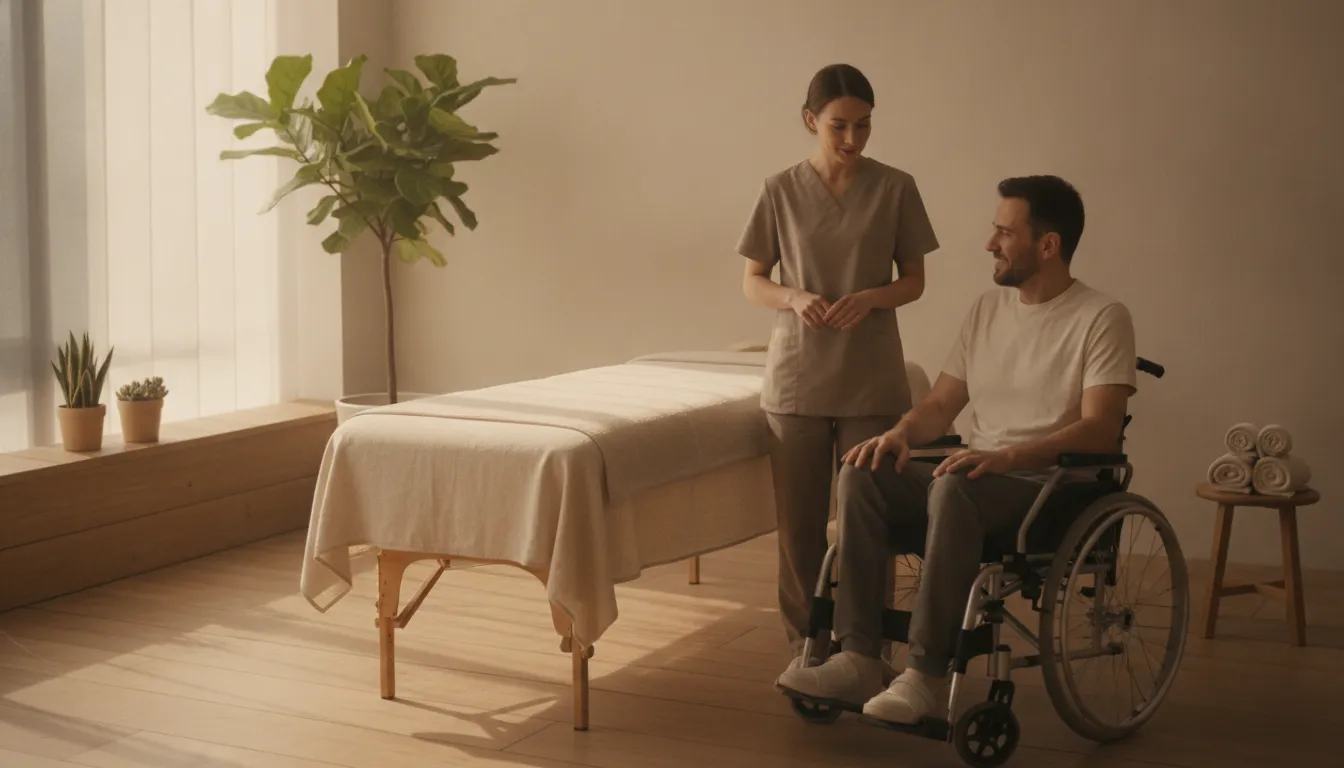
Massage for ALS is a comfort conversation, not a treatment plan you can pick from a menu. ALS, also called amyotrophic lateral sclerosis and formerly Lou Gehrig’s disease, weakens the muscles that move the body and support breathing. A useful first step is the clinician who already knows the person. After that, a licensed massage therapist can talk through pressure, position, and when to stop.
Talk with NOLA Bliss before you book
What does massage for ALS mean in practice?
The National Institute of Neurological Disorders and Stroke describes ALS as a disorder of motor neurons, the nerve cells that start voluntary movement. As those cells die, muscles weaken, twitch, and waste. Over time, walking, speaking, chewing, and breathing can become harder. The institute says there is no treatment that stops or reverses ALS, though some medicines may slow decline or ease symptoms.
Massage does not replace that medical plan. It does not slow the loss of motor neurons, replace a breathing device, or stand in for physical, occupational, speech, or respiratory therapy. Some people and caregivers still look at hands-on work as one comfort tool beside the clinical team.
A 2009 article by Kendra Blatzheim, published in the Journal of Bodywork and Movement Therapies, describes an interdisciplinary palliative-care approach that includes massage as a possible adjunct for spasticity and pain when medication side effects are unwanted. It is an article about a care approach, not proof that a spa session will reduce pain, stiffness, or fatigue. It reinforces that massage, if considered, belongs within a larger plan with the clinical team still in charge.
NOLA Bliss Massage is a therapeutic studio in the Warehouse District, led by licensed massage therapist Sara Albee. The team offers Swedish and deep tissue massage, Ashiatsu, prenatal massage, and couples sessions, and pressure is adjusted to the person. None of those service names decides whether massage for ALS is appropriate. The person’s clinician does that. The studio can then say whether a careful, light session is something they can provide that day.
The practical meaning is small on purpose. You describe today’s strength, breathing, swallowing, and skin. The therapist explains what hands-on work would involve. You agree on a modest goal, such as a calm rest or light contact on one area, and you keep the right to pause.
How do changing symptoms change a session?
ALS is progressive, so a plan that fit last month can be wrong today. Early signs listed by the neurological institute include muscle twitches, cramps, stiff muscles, weakness in an arm or leg, and slurred speech. Later, chewing, swallowing, drooling, speaking, and breathing can all be affected. Many people stay able to think clearly while movement becomes harder, which makes clear consent and a slow pace even more important.
That pattern should change the session, not just the talking points. A person who can still turn in bed may want a short Swedish-style session on the back and shoulders. A person who cannot reposition may need the therapist to work only on the surfaces that are already easy to reach. Deep pressure is not a remedy for stiffness, and a relaxation massage is not automatically safer if breathing is labored.
The ALS Association’s nursing guidance says teams should check motor strength, note whether muscles are tight or floppy, watch for contractures, and look at skin every day. It also says range-of-motion work starts as active movement and later becomes passive, and that a physical therapist should guide that program. A massage visit is not that program. If joint pain or tightness is the main issue, ask the therapy team before anyone adds stretching on the table.
Fatigue is another limiter. A session that feels pleasant for twenty minutes can leave someone wiped out for the rest of the day. Shorter is often better. Pick a goal you can name in one sentence. One example is easing a tight feeling in the calves without a turn. Another is helping the shoulders rest while the person stays upright.
What should you ask the care team before you book?
Bring the massage idea to the neurologist, palliative clinician, or therapy team before you reserve a time. Ask whether hands-on work is acceptable this month, which areas to avoid, and whether breathing, skin, or swallowing changes should cancel the visit. Write the answers down so the massage therapist is not guessing from a short intake form.
Use a short checklist:
- Ask whether massage is appropriate right now, and which body areas to leave alone.
- Note breathing support, a feeding tube, a catheter, or fragile skin that changes how someone can lie down.
- Name one comfort goal, not a list of techniques.
- Decide who will speak for the person if speech is hard that day, and how they will signal stop.
- Plan the ride, the transfer, and a rest afterward before you look at the clock.
If the team says not yet, that answer stands. A coupon, a walk-in slot, or a well-reviewed deep tissue menu does not override it. NOLA Bliss massage services are built for therapeutic goals such as Swedish, deep tissue, and Ashiatsu work. Those options are a starting menu for many guests. They are not a protocol for ALS.
Which comfort goals fit, and which do not?
A fitting goal is modest and reversible. People often want less of the tight, crampy feeling in the neck, shoulders, low back, or calves, or a calmer rest when anxiety is high. The neurological institute notes that pain, stiffness, and the emotional weight of losing function are part of living with ALS. Massage might be one way to feel cared for during a hard week. It is not a way to regain strength.
Goals that do not fit include “loosen the contractures,” “drain the swelling,” “fix the breathing,” or “work out the knots so walking improves.” Those jobs belong to the clinical team. Manual lymphatic work, aggressive stretching, and deep pressure are specific skills with their own risks, and they are not something to try because a general article said massage can help.
The table below is a planning aid, not a prescription. If today’s symptoms do not match a row, skip the visit or ask the clinician again.
| What you notice today | A careful massage goal | Pause and call the care team |
|---|---|---|
| Mild stiffness in the neck, shoulders, or calves. Breathing is usual for this person. | Short, light contact on the comfortable side. Use an easy stop signal. | New or severe cramping. Chest pain. A big change in breathing. |
| Fatigue is high. The person can still tolerate a brief upright rest. | A shorter visit. Fewer turns. No goal beyond comfort. | Fever, sudden weakness, or exhaustion that is new |
| Skin is intact. The person can say what pressure feels like. | Very light pressure, checked often. No work over bony spots. | Redness, a wound, or a new bruise. Skin that stays pale after a turn. |
| Swallowing or speech is harder than usual. | Delay the visit until the clinician says a calm session is still reasonable. | Choking. Drooling that is hard to manage. A new breathing struggle. |
Read the right-hand column before you read the middle one. A comfort goal only matters when the reason to pause is absent.
How should positioning and breathing shape the visit?
Position is often the whole session. Many people with ALS cannot lie flat, roll, or hold an arm up. The ALS Association nursing guidance recommends varying positions about every two hours or according to skin tolerance, checking bony prominences, and using appropriate support such as a sling for a weak upper extremity. A one-hour massage that requires three transfers can undo the point of coming in.
Say what already works at home. If the person rests best in a recliner, semi-upright, or on one side with pillows, start there. Do not force a face-down position so the therapist can reach the back. The therapist can work the neck, hands, calves, or the side that is already up. If a transfer needs two trained people at home, do not assume a massage room can repeat it safely.
Breathing needs the same honesty. Shortness of breath, a cough assist, or noninvasive ventilation changes what “relax on the table” means. Keep the head and chest in the position the respiratory team already approved. If talking makes breathing harder, agree on a hand squeeze for “less pressure” and a second signal for “stop.” A caregiver who knows those signals should stay close enough to help.
Heat, cold, and strong oils are optional extras, not requirements. Skip them when sensation is patchy or the person cannot report discomfort. Fragrance can also bother someone who is already working hard to breathe. Plain, light contact is enough.
What should you tell the massage therapist?
The intake should sound like a handoff, not a spa preference card. Share the diagnosis in plain words, the clinician’s yes or no, and what changed in the last two weeks. Name devices, skin risks, medicines that affect bruising or clotting, and any area that hurts when it is touched. If speech is tiring, a caregiver can read a short note while the person confirms with a nod.
Pressure is a live choice, not a style on the booking form. Ask the therapist to start lighter than usual and to check in after each small area. “Medium” means nothing if the person cannot reposition or speak easily. Pain is not a sign that the work is effective. It is a reason to lighten up or stop.
Also say what the visit is not. NOLA Bliss does not diagnose ALS, adjust respiratory equipment, or replace the physical therapy home program. If you want help comparing massage with clinical therapy, the studio’s guide to massage therapy versus physical therapy separates those roles. For a related comfort question about swelling, read how to discuss massage for swelling before you assume hands-on work is useful.
Older guests, and caregivers who are sore from lifting, sometimes need their own plan. Massage therapy for seniors covers pacing, positioning, and session length for people who need a gentler visit. That page is not an ALS guide, but the same pacing idea applies to the caregiver who books a separate appointment.
How do you plan the trip to a New Orleans studio?
The trip can cost more energy than the session. NOLA Bliss is in the Warehouse District at 322 Lafayette Street, Suite 300, New Orleans, LA 70130. Call or text 504-615-9414 if you need to ask about access before you arrive. The studio publishes free parking instructions, which matter when a transfer takes time and a caregiver is driving.
Build slack into the appointment. A person who uses a wheelchair or needs help with a jacket may not want a tight turnaround. Ask whether the room allows a caregiver to stay, where a wheelchair can sit, and whether the table height can be adjusted. If stairs, a long walk from the car, or a face-down setup would be required, say so before the day of the visit.
Time of day matters too. Some people breathe and transfer more easily in the late morning. Others are done by early afternoon. Book the hour when the person is usually most alert, and leave room to cancel the same day if breathing, fever, or a skin change shows up. A missed appointment is cheaper than a session that has to stop in the first five minutes.
Caregivers need a plan as well. The neurological institute notes that caregiving gets heavier as ALS progresses, and that caregivers should look after their own health. If you want bodywork for yourself, book it as your visit, not as something squeezed into the person’s session. You can compare ordinary recovery goals on the page about therapeutic massage and injury recovery, then keep the ALS visit separate and shorter.
See massage services and plan the next step
Frequently asked questions
Can massage slow or treat ALS?
No. The National Institute of Neurological Disorders and Stroke says no current treatment stops or reverses ALS. Massage does not change the disease. At most, some people use it for comfort beside medicines, therapy, and breathing care their clinicians already direct.
Is deep tissue a good idea for muscle stiffness?
Not as a default. Stiffness, cramps, and weakness can show up together, and deep pressure can be too much when someone cannot move away or speak easily. Start with the clinician’s limits, then ask for light contact and frequent check-ins. Increase nothing on the first visit.
What if breathing, swallowing, or skin changes on the day of the visit?
Cancel or postpone. New shortness of breath, choking, a fever, or a red area over a bone is a clinical question, not a massage adjustment. The ALS Association’s nursing guidance treats positioning and skin checks as ongoing care, which is a reason to stay home when those things look worse.
Should a caregiver get massage too?
Often the caregiver’s neck, back, and sleep need attention, but that is a different appointment. Do not turn the person’s ALS visit into a couples or add-on session. Book a separate time, and keep the ALS visit focused on the comfort goal the care team already allowed.
What should we bring to NOLA Bliss?
Bring the clinician’s guidance, a list of areas to avoid, and the stop signal you will use. Wear clothes that make transfers simple. If a recliner-style rest works better than lying flat, say that when you contact the studio so the therapist can plan the room before you arrive.